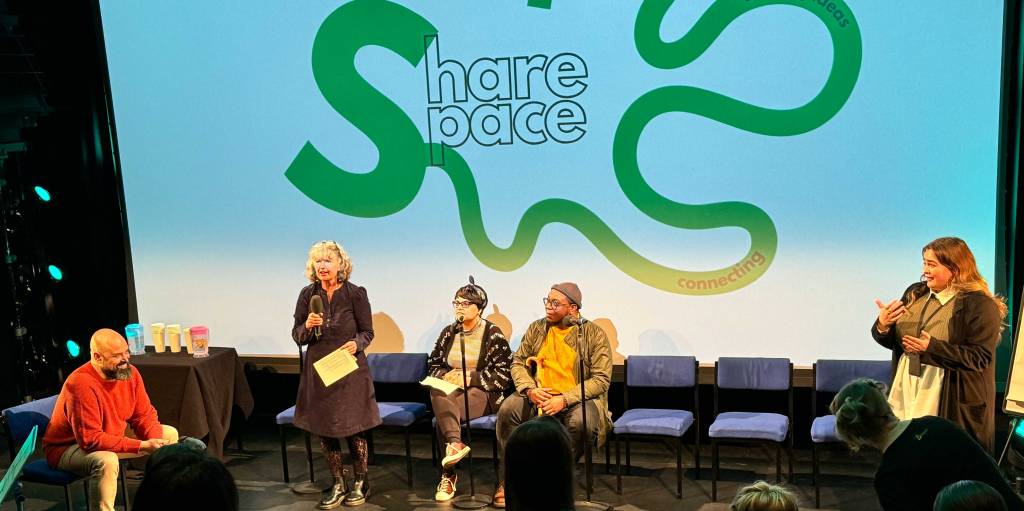
Building connections and collaboration between Deaf and hearing artists, creatives and cultural organisations in the Black Country (and beyond) This conference was hosted by VV artist Ishtaiq Hussain.
The event opened up with a conversation between Kelly Parish (Arts council) and Alan Mclean (Deaf explorer.)
“We are here today to find out more about how to make the sector think differently about deaf Creative people, rather than how can the sector be inclusive so we can have equity and creativity.”
In this part of the panel 3 key themes were mentioned: community, workforce development and creative case. Alan introduced the work of Deaf explorer by saying “Over the past 5 years, we have produced Deaf Artists work. We have learnt how to overcome the challenges and barriers that stop deaf artists progressing in the arts. For example, Rinkoo Barpaga. Who was at the start of Deaf Explorer with a Trip to New York to learn stand up comedy and then to Edinburgh with a Pleasance Commission, after amazing reviews toured UK bringing deaf audiences to theatres to watch a solo show in BSL.” He is an example that with the right connections, considerations and support anything is possible. Also how vital representation of intersectionality is. A deaf brown man challenging and changing perceptions on what accessible theatre can look like.
Kelly talked about the DYCP (Develop your creative practice) and how it can be used by deaf individuals to learn skills to make them leaders, organisers and producers in their community. An example is Kevaughn Laing, a deaf dancer who was granted a DYCP to be a dance leader and to develop new work. Someone in the audience asked how hearing people can learn the skills to communicate better with deaf people. Kelly mentioned how the DYCP can also be used to learn BSL, VV to connect with the deaf community. Alan discussed a BSL Level 1 course for people in the creative sector to improve collaboration with Deaf people. This shows the steps being made to expand on community. The Belgrade theatre and the REP are also working on a BSL slam to reflect the thriving poetry scene in the city and making sure deaf voices are involved.
The conversation was a reminder that accessibility for deaf people is much more than having an interpreter and there needs to be a focus on community. “It is important to look at leadership in organisations and grass roots, asking communities what culture do they want and having the appropriate ambassadors to work with and communicate on the ground.” Deaf talent isn’t going anywhere and its about uplifting their voices and making sure they are being supported and represented by the arts sector.
“Better decisions can be made about making shows accessible if you consult before with the community you want to reach”
Alan discussed the intersectionality of deaf identities and that they are helping to uplift and promote voices from the LGBTQIA+ community and south Asian backgrounds. “By consulting with deaf artists The barriers multiply when combined with protected characteristics of Race, Age, Disability, Gender reassignment, sexual preference, religion or belief. Our ethos is that Deaf artists are not just one homogeneous Deaf culture they always intersect with other kinds of cultural identity, making our practice focused on inclusion.” Inevitably peoples backgrounds, experiences and identities influence the work they will make. This links to a discussion had around how deaf artists need to be seen as creatives first. Before that, as regular people.
There was also discussion about consultancy work and how change can’t take place without communication and education. “Deaf Explorer act as broker supporting the hearing sector to meet their ambitions of involving Deaf artists. The question is how, and on what terms? Deaf Creatives need to be given the opportunity to lead and be involved earlier in planning of projects, Festivals and commissions.” Accessibility needs to be something that is integrated into arts organisations to create equal opportunity.
There was a focus on deaf people having a seat at the table and their thoughts and opinions being valued and prioritised opposed to an afterthought. “We recognised that if more deaf representation on boards of arts organisations there would be more opportunities and different thinking about access eg. access ryders booking interps. Also impacting on commissioning decisions.”
Being able to have discourse around people’s needs to one person or organisation then effects a community which is how change is created. It was inspiring seeing the work that Deaf explorer are doing to expand the deaf workforce, educate and equip the hearing world thus building community.
The upcoming conference away days has the purpose of promoting allyship between deaf and hearing people. This has been organised by Mary-Jayne Russell de Clifford: Theatre facilitator, director, scriptwriter, BSL storyteller, BSL poet, BSL consultant, producer and mentor. Mary Jayne spoke about Vamos theatre “the UK’s leading full mask theatre company, taking its funny and fearless brand of wordless theatre across the length and breadth of the country and beyond since 2006.”
The discussion was around the inherent accessibility of the theatre as there is no dialogue, with full focus on the masks and body language. Due to this it has a big appeal to deaf audiences and the theatre has been able to make multiple connections with the deaf community they are wanting to expand on. This would be by working with more deaf people internally in the company. They also offer workshops to share their skillset and type of theatre with people of all backgrounds.
Mary Jayne expanded on being a deaf person in the theatre sect and the etiquette around hiring an interpreter in the arts. How important it is for hearing folks to consider what kind of interpreter they are looking for. If you want someone for a theatre show you wouldn’t hire an interpreter who is used for courtrooms as they lack the knowledge needed. Due to the specificity of theatre and the terminology used the interpreter hired should have a degree and/or extensive training and experience in theatre. It’s not as simple as hiring an interpreter and claiming you’re accessible. Someone asked in different cities in the UK are approaching deaf accessibility differently. The answer was yes and because some cities are behind others most of Mary Jaynes work happens outside of the West Midlands. This highlighted why conferences like this are so crucial.
Frances Land from Black country touring mentioned the lack of interpreters for the demand and how she hopes to see it rise in future.
The host then did a talk about his role as a deaf leader in the community. Ishtaek Hussain is a VV artist and director of Deafscope, which is a Deaf-led organisation that aims to bring all diversities within the Deaf and Deaf Ushers Community together. They provide training opportunities and the chance to gain new skills through: I.T, fitness, health and educational workshops – to enhance the lives of the Deaf and Deaf Ushers community. He talked about the effect the pandemic had on the deaf community in terms of isolation. This prompted him to start doing online VV workshops. VV standing for visual vernacular which is the equivalent of deaf poetry. He discussed how he has trained up people who are now experts who initially didn’t know what VV was. It’s a niche and beautiful art form that he is passionate about sharing with other people. The only issue is being able to keep up with the demand and its something that wasn’t sustainable long term. Ishtaek mentioned hosting an Eid celebration in his hometown and doing a VV performance and the joys of being able to share it with hearing people.
Him and Adrian B Earle (Writer, poet and media maker, Think Write Fly) collaborated on a piece across community gardens in Birmingham called where we grow. They spent time with gardeners and volunteers which inspired a performance of VV and spoken word that responded to the others art form. The process of the piece was both artists learning about each others art form which culminated in a beautiful spiritual and almost ritualistic piece. It’s a prime example of how deaf and hearing artists can not only co-exist in spaces but make poignant work. This piece was produced by Black country touring. Samphira Al-Fhiri and Frances Land from the company talked about their experiences of working with a deaf artist. It was eye opening for them and has influenced how they work deaf and hearing artists. It shows that collaboration with deaf and hearing artists is possible it just requires consultation, communication and willingness to learn and adapt.
This event was produced by curiosity productions who want “An arts and cultural sector that is representative, accessible and inclusive for all.” led by creative director Jenny Smith. They have a specific interest in children and families. It was clear from this conference that part of the intention of creating conversations around allyship is so that deaf kids can grow up knowing that they can be deaf artists bcause there will be an infrastructure for it.
This event was supported by CEDIA, the Centre for Equality, Diversity and Inclusion at Birmingham City University. It was hosted by the Arena Theatre and produced by Curiosity Productions for Creative Black Country.
By Ray Vincent-Mills
 Deaf Explorer