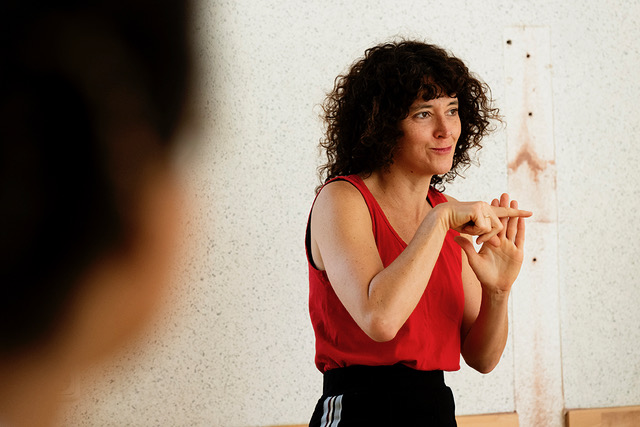
Free professional dance workshop for emerging deaf artists 7th April Dance workshop with Neus Gil Cortes and Anna Seymour. Fabric at the hippodrome. With interpretation from Rachael Radford.
Neus Gil Cortes choreographic work exists in the meeting of cultures, places and backgrounds. With a focus on increasing the diversity of bodies and life experiences of those on stage as a first step to diversify audiences. Neus regularly works with a team of Deaf and hearing dance artists of different backgrounds. She created her own dance company Nua dance in 2015 and currently works as a dancer, choreographer and educator. Her work feeds from dance, circus, visual arts and has been performed around Europe and the USA. Her pieces offer different accessibility options for Deaf audiences embedded from the beginning of the process.
This workshop comes off the back of Neus’ UK tour of her film noise in partnership with Deaf Explorer.
There was a focus on the dancers not looking at themselves as she wanted them to find their own rhythm based on feeling opposed to judgment. After the warm up the dancers were asked to move from one side of the room to the other, whilst staying soft and paying attention to the movement in their neck and ankles.
The metaphor of a palm tree in a hurricane was used. No matter how much the wind blows they bend and adapt to the surroundings. The dancers were urged to view their body in a similar way moving and adapting to the music, vibrations and energy.
Gaga was mentioned: regaining intuition of movement instead of it being structured in a certain way that corresponds to beats. It helps the dancer connect the moves to their imagination.
Navigating from one end of the room to the other was used multiple times with different prompts each time. Neus’ talked about how the everyday movements of walking and running are out of balance, they can base their movements on that. This included incorporating falls and turning them into movement “your body will know what to do.” There was also a reminder that it’s not about how it looks in the mirror but how it feels in the body.
The next iteration of this was “Let your body expand as if it were made out of gum or something.” The dancers moved two at a time so that people could draw inspiration from each other. One of the dancers mentioned that although she has been dancing for years its always nice to have the reminder to keep the neck and ankles sot and loose. With BSL the neck is often rigid for perception purposes so it feels scary to let go of the visual information. A discussion opened up about if there were any links to balance.
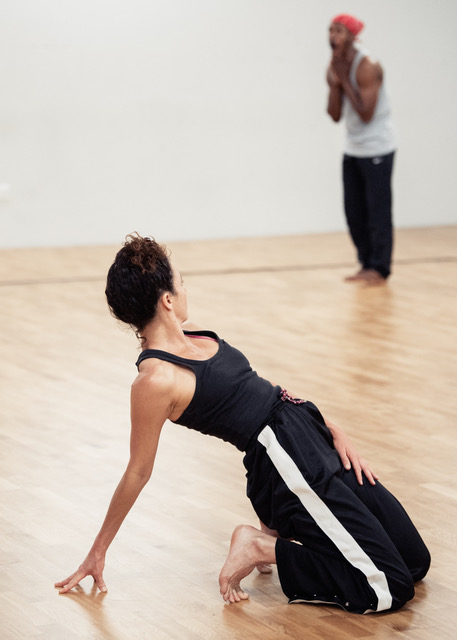
“Push your own limits but within your body.” It was beautiful to see how peoples movements evolved as they got more comfortable in the space, with themselves and around each other. The dancers were asked to move across the room in pairs and to follow each other’s rhythm whilst connecting with each other and to “feel the positive tension.” Between each exercise people shared how they were feeling and asked any questions they might have had. It became a space where there were no silly questions or wrong movements.
Neus’ talked about how dancers are often wary of standing still due to the nature of the artform but that there is power in stopping. Keeping the audience guessing. Creating and maintaining suspense.
After the exercises the dancers were given twenty minutes to create their own solo pieces all exploring different themes and emotions. With Neus’ saying “Once you’ve choregraphed step into the performance hat.” It was interesting to see how each person utilised different parts of the room. The first dancer incorporated the wall with a piece that was equal parts thoughtful, beautiful and pensive ‘I wanted to express being pulled and pushed in different directions.’
The second dancer incorporated the mirrors into his performance in a way that was moody, reflective and emotional. Diagonal corners of the room were used as places that had “No solid destinations, only ideas.” The piece ended with a moment of stillness that represented moving into a new cycle.
The third dancer incorporated a large pillar next to the window of the studio. It was captivating and drew in the audience due to the contrast between the size of her and the vastness of her surroundings, which was beautifully concisely conveyed in the piece.
After this the dancers were tasked with dancing with each other with contact improv. This resulted in a beautiful mass of pulsing twists and turns in a way that can only be described as being sublimely alive and present. Neus’ would stamp her foot on the ground to signal a stop and that the dancers should pay attention to these stops and starts with finding softness in each other’s bodies and seeing where theirs naturally landed.
A dancer whos’ first time it was dancing with others said ‘It’s really nice to navigate how other people respond to contact.’
After Lunch was a workshop with Anna Seymour, an Australian born Deaf dancer and performer living in London dancing with Candico dance company. Anna created spin ‘An interactive dance/rave performance with three Deaf hosts and a DJ. Inspired by club culture and social dance scenes in Sn Francisco, Mexico, Cuba and Berlin. SPIN celebrates connection, escapism and the power of ritual. SPIN was recently performed with UK deaf dance artists Chris Fonseca and Raffie Julien at the 2024 Sydney festival in Australia.
It began with Anna asking the dancers what they’ve learnt from the first workshop.
“Questioning ideas and breaking boundaries within them.”
“Allowing myself to improvise.”
‘Thinking about space and pace it was challenging but I learnt a lot.’
“I’ve discovered more possibilities in my body with less rigid movement.”
The dancers talked about their relationship to the artform and their Deafness.
Anna talked about dancing in high school but stopping because of the barriers and lack of accessibility around her Deafness but she was always drawn back to dance.
There was a similar story of someone wanting to pursue dance as a teenager but it not being accessible so at 17 he dropped dance and trained as a chef. He stopped dancing for 15 years then Maral former creative director at deaf explorer asked him to perform 3 years ago. This led to him becoming more confident and has now acquired arts council funding to work on his skillset as a dancer. Deaf explorer are also supporting him. He is doing this alongside being a chef and is happy to have dance back in his life. Though there is still a lot of negativity and disbelief surrounding deaf dancers.
Someone else discussed dancing since she was 2.5 years old with ballet then going into contemporary. She started wearing hearing aids in college and it was hard to navigate hearing along with dance. She is now studying dance at degree level but her access needs are not really considered. She expressed how nice it was to be in a space tailored towards deaf dancers, even small things like tapping the floor to signal a start/stop.
The last dancer spoke about navigating hearing loss and how it helped him to harness his creativity. He has been recently connecting with dancers about their deafness.
This concluded in Anna saying that deafness is a spectrum and that there is no such thing as being culturally deaf or not being deaf enough.
The warmup for the session was centred around the hips and pelvis as ‘they hold all the information and power.’ They are points of the body that help release tension.
It was discussed that there are lots of stereotypes around deaf dancers, that they can’t do it because of the music. This can trickle down into the Deaf community as there’s a fear that trying dance will make them look stupid. There becomes an internalised discrimination around what can and cannot be done. This reinforced how vital it is to have spaces like this for deaf dancers to move, explore and experiment with each other without judgement and the expectations of the hearing world.
An exercise was given to the dancers that they can move around the space within the confinements of standing, sitting, walking and running. and that it holds an archive of movement within it. There was freedom and empowerment of transforming everyday movements into dance.
“Opportunity to be as fluid as you want with these movements, have fun be experimental.”
“Think of your body as a free element.”
Afterwards there was an exercise based on Anna’s piece spin which she shared a clip of with the group. Based on follow the leader each dancer lead the group with movements as everyone followed. No words just a focus of communicating and connecting with the body and exploring the synergy between the dancers.
Thank you Ray Vincent-Mills
 Deaf Explorer